
What Is Korean Skincare? Everything You Need to Know About K-Beauty
Korean skincare widely known as K-beauty is a philosophy-led approach to skin health that prioritises long-term barrier function, consistent hydration, and prevention over correction. It is not simply a collection of products from South Korea. It is a fundamentally different way of thinking about what skin needs and how to give it those things , one that has reshaped global beauty standards over the last decade and continues to lead ingredient and formulation innovation in 2026. If you have ever looked at someone with genuinely healthy, even, luminous skin and wondered what they use, the answer very often begins with the K-beauty philosophy.
This guide covers what Korean skincare actually is, why it works the way it does, which ingredients define it, and how to start building it into your own routine from the foundation up.
Korean skincare does not start with a product. It starts with a question: what does this specific skin actually need right now and what is the gentlest, most effective way to give it that?
The Philosophy Behind Korean Skincare
The single most important thing to understand about Korean skincare is that it starts from a different premise than Western beauty. Western skincare has historically been correction-focused identify a problem, apply a targeted fix, measure the result. This model produces products that work on specific issues in the short term but often ignore the broader skin environment in which those issues exist.
Korean skincare flips that model. The skin barrier is the outermost protective layer of the skin .It is treated as the foundation of every outcome. A healthy, intact barrier retains moisture effectively, protects against environmental stress, regulates inflammation, and responds better to active ingredients. A compromised barrier produces exactly the opposite: dehydration, sensitivity, uneven tone, and poor results from even the best actives. K-beauty builds from the barrier up, not from the problem inward.
This shift in starting point changes everything downstream which ingredients are used, in what concentrations, in what order, and at what frequency. It is why Korean skincare produces results that are often described as cumulative and gradual rather than dramatic and temporary. The goal is skin that functions better over time, not skin that looks better tomorrow at the cost of tomorrow’s barrier.
2026 Market Context: South Korea became the world’s second-largest cosmetics exporter in early 2025, reaching $3.61 billion just behind the United States. As covered in a 2026 analysis of how Korean skincare is shaping modern beauty, this growth reflects a consumer shift toward prevention-first, science-backed skin health that K-beauty pioneered before the rest of the market caught up.
What Is the Skin Barrier
The skin barrier is technically the stratum corneum, the outermost layer of the epidermis. It is made up of skin cells bound together by lipids including ceramides, fatty acids, and cholesterol. This structure functions like a brick wall: the cells are the bricks, the lipids are the mortar. When both are intact, the barrier keeps moisture in and environmental aggressors out with remarkable efficiency.
When the barrier is damaged by over-exfoliation, harsh cleansers, environmental pollution, sun exposure, or simply using products that are not pH-appropriate that mortar breaks down. Moisture escapes. Irritants penetrate more easily. The skin becomes reactive, dry, and prone to the very problems most people are trying to solve with stronger products. The stronger products then damage the barrier further. This is the cycle that K-beauty interrupts.
- Ceramides: lipids that form the structural mortar of the skin barrier. Depleted by age, harsh products, and environmental stress. Central to K-beauty moisturiser formulations.
- Panthenol (Vitamin B5): draws moisture into the skin and supports barrier repair. One of the most consistently used barrier-support ingredients across the K-beauty range.
- Madecassoside / Centella Asiatica: plant-derived ingredient with strong clinical evidence for reducing barrier inflammation and accelerating skin repair.
- Beta-Glucan: polysaccharide that hydrates deeply and supports barrier function , some studies show stronger moisture retention than hyaluronic acid in certain formulations.
The Core Korean Skincare Routine
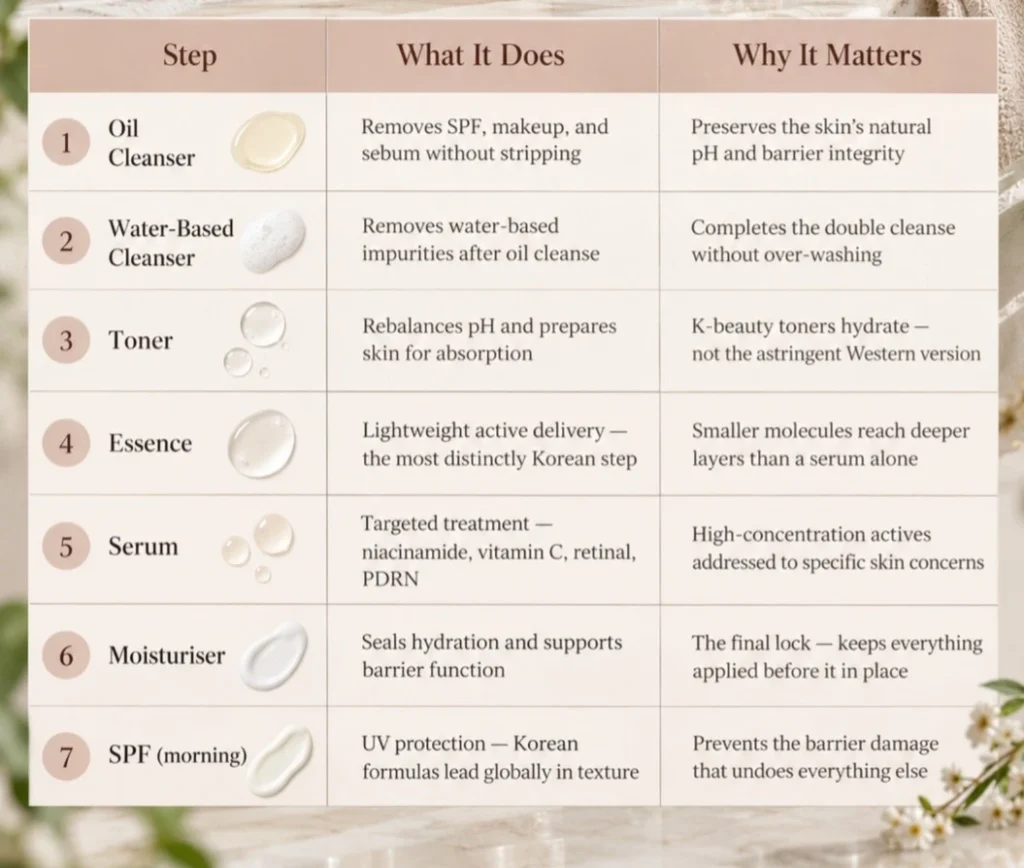
Not every K-beauty routine uses all seven steps. A minimalist version , gentle cleanser, toner, serum, moisturiser, SPF delivers the core benefits without the time commitment. The multi-step version is most valuable when specific skin concerns need targeted address at multiple levels simultaneously.
The Key Ingredients That Define Korean Skincare
Korean skincare introduced several ingredients to the global mainstream that Western beauty had either ignored or significantly underused. These are not trend actives , they are clinically validated ingredients with years of dermatological research behind them. Understanding them helps you read a K-beauty product label intelligently rather than relying on brand claims.
Niacinamide
One of the most versatile actives in modern skincare. Niacinamide regulates sebum production, reduces the appearance of enlarged pores, improves uneven skin tone, strengthens the skin barrier, and is well-tolerated across all skin types including sensitive and acne-prone. Korean brands were using it at effective concentrations 5% to 10% in mass-market products before it became a mainstream Western ingredient.
Centella Asiatica (Cica)
A traditional Korean botanical used in dermatology for its barrier-calming and repair properties. Clinical research supports its role in reducing skin inflammation, supporting collagen synthesis, and improving tolerance to other active ingredients. It is the go-to ingredient in K-beauty for sensitised or compromised skin.
Adenosine
A naturally occurring molecule that supports skin firmness and smoothness by promoting the production of collagen and elastin. Widely used in Korean anti-ageing formulations as a well-tolerated alternative to retinol for those with sensitive skin.
Snail Secretion Filtrate
One of the most distinctly Korean skincare ingredients. Collected humanely from farmed snails, snail mucin contains a combination of glycoproteins, hyaluronic acid, and enzymes that support hydration, barrier repair, and skin texture improvement. Clinical evidence on its effectiveness has grown significantly since it entered the mainstream.
Retinal (not Retinol)
Korean brands pioneered the use of retinal the aldehyde form of vitamin A, one conversion step closer to retinoic acid than retinol as a more effective and less irritating retinoid alternative. Retinal delivers results similar to prescription retinoids at significantly lower irritation levels, making it suitable for consistent daily use in a way that retinol often is not.
Korean Skincare vs Western Skincare — The Key Differences
The gap between Korean and Western skincare is not about product quality ,it is about formulation philosophy, ingredient prioritisation, and the speed at which clinical research is translated into commercial products. As K-beauty trend analysis from TheGlowPick covering 2026 developments notes, 2026 has seen K-beauty’s barrier-first philosophy become the default approach across the Korean skincare industry , a shift that Western brands are only beginning to replicate.
What Is Glass Skin — And Is It Actually Achievable
Glass skin is a Korean aesthetic ideal that describes a complexion so well-hydrated and even-toned that it appears almost translucent , smooth, luminous, with no visible texture, dryness, or unevenness. It became a viral concept globally around 2018 and has remained one of the most searched skincare goals ever since.
The important context is that glass skin is not a filter effect or an Instagram aesthetic. It is a skin condition that results from consistent barrier health, adequate hydration, and minimal inflammation. It is achievable by most people with a consistent K-beauty routine focused on barrier support and layered hydration but it takes weeks to months of consistent practice, not a single product. The viral version of glass skin often involves makeup techniques that mimic the appearance. The K-beauty version is built from the inside of the skin outward over time.
Korean Skincare in 2026 — Where the Industry Is Going
Korean skincare continues to evolve faster than any other segment of the global beauty industry. The 10-step routine that defined K-beauty’s early mainstream identity has given way to a more intentional, quality-over-quantity philosophy fewer products, higher-efficacy formulations, and ingredients that work deeper within the skin.
- PDRN (Polydeoxyribonucleotide): salmon DNA-derived ingredient originally used in clinical aesthetics. Now entering mainstream K-beauty for its skin repair and regeneration support. 2025 was the breakout year for PDRN; 2026 is the year it became a standard.
- EGF (Epidermal Growth Factor): supports skin repair and elasticity at a cellular level. Moving from Korean clinic treatments into at-home K-beauty formulations in 2026.
- Electroporation devices: at-home technology that drives active ingredients deeper into the skin than topical application alone achieves. Korean brands are leading the translation of clinical device technology into accessible consumer formats.
- Intelligent minimalism: the industry’s shift away from routine complexity toward a smaller number of highly effective, multi-functional products. Barrier health remains the primary objective; the approach is becoming more focused, not more expansive.
The 2026 Direction: The single biggest K-beauty trend in 2026 is the consolidation of barrier-first thinking as the industry’s default philosophy not a niche approach but the standard. Brands that built their identity around aggressive actives and correction are reformulating. The prevention-first, barrier-supportive model that Korean skincare pioneered is now the global benchmark.