AHA vs BHA vs PHA — Which Exfoliant Is Right for Your Skin?
Chemical exfoliants are one of the most effective tools in any skincare routine but AHA vs BHA vs PHA is a genuine choice, not just a branding difference. Each one works through a different mechanism, reaches a different layer of the skin, and is suited to a different skin type and concern. Using the wrong one does not just mean missing out on results it can actively worsen sensitivity, barrier damage, or breakouts depending on what your skin needs. This guide gives you the complete, practical answer.
AHA — Alpha Hydroxy Acid
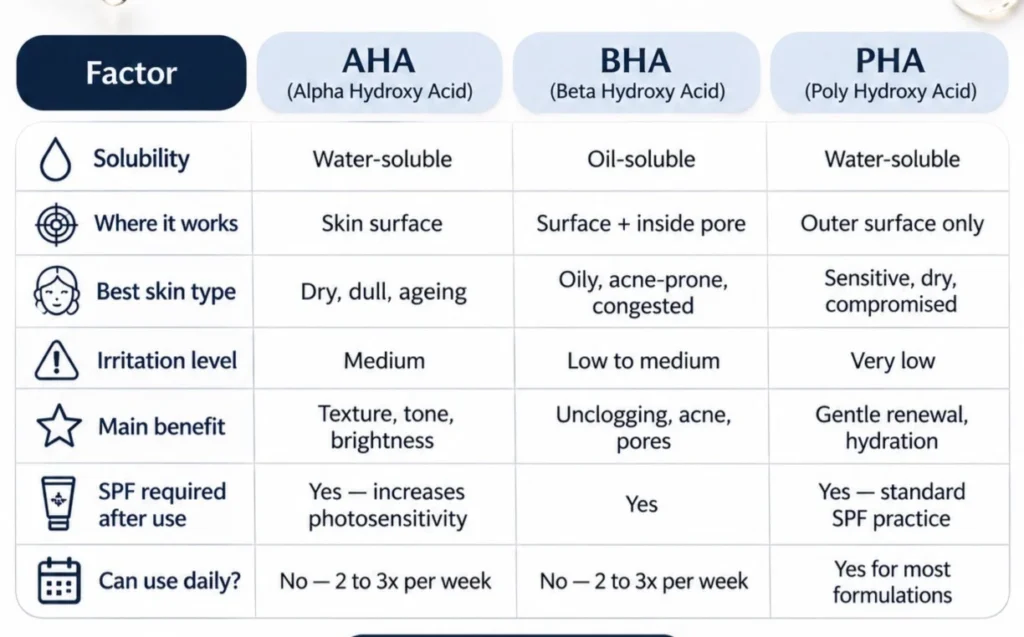
AHAs are water-soluble acids that work on the skin’s surface. They dissolve the bonds between dead skin cells in the outermost layer of the epidermis, allowing them to shed more effectively. The result is progressively smoother texture, more even tone, and a brighter complexion with consistent use.
The most common AHAs in skincare are glycolic acid — the smallest molecule, deepest penetration — and lactic acid, which is gentler and more hydrating. Mandelic acid is a larger-molecule option well-suited to darker skin tones where over-exfoliation can trigger post-inflammatory hyperpigmentation.
- Best for: dry skin, dull skin, uneven texture, fine lines, hyperpigmentation.
- Not ideal for: active acne, oily skin with congestion, compromised or sensitive barrier — AHAs increase photosensitivity and require consistent SPF use.
- Frequency: 2 to 3 times per week maximum. Daily use at higher concentrations degrades the barrier faster than it can repair itself.
BHA — Beta Hydroxy Acid
BHA — primarily salicylic acid is oil-soluble, which means it can penetrate into the pore lining rather than working only on the surface. This is the defining difference between AHA and BHA. Because it reaches inside the pore, BHA dissolves the sebum, dead skin cells, and debris that cause congestion, blackheads, and acne from within not just from the top down.
BHA is also anti-inflammatory and mildly antibacterial, which makes it doubly useful for acne-prone skin it addresses both the clogging and the bacterial environment that worsens breakouts simultaneously.
- Best for: oily skin, acne-prone skin, congestion, blackheads, enlarged pores, sebaceous filaments.
- Not ideal for: dry or dehydrated skin BHA’s oil-dissolving action can tip already dry skin toward further dehydration and sensitivity.
- Frequency: 2 to 3 times per week for most skin types. Oily, resilient skin can tolerate daily low-concentration BHA. Introduce slowly.
PHA — Polyhydroxy Acid
PHAs are the newest category and the gentlest of the three. They are larger molecules than AHAs, which means they penetrate the skin more slowly and work predominantly at the very surface of the stratum corneum. The exfoliation is gradual rather than intensive and that is precisely the point.
PHAs also carry humectant properties they attract moisture to the skin as they work, which means they exfoliate without stripping. This dual action makes them the only exfoliant category that can support barrier function and exfoliate simultaneously rather than trading one for the other. Gluconolactone and lactobionic acid are the most common PHAs in K-beauty formulations.
- Best for: sensitive skin, dry skin, barrier-compromised skin, beginners to chemical exfoliation, rosacea-prone skin, skin in a repair phase.
- Not ideal for: anyone expecting rapid, visible exfoliation results , PHA works gradually. If significant texture or congestion is the primary concern, AHA or BHA will produce faster visible improvement.
- Frequency: can be used daily in most formulations , the gentleness of the molecule makes daily use appropriate for most skin types.
AHA vs BHA vs PHA — Side-by-Side Comparison
All Three in One Step — How Medicube Uses This Combination
One of the most practical aspects of K-beauty formulation is the multi-acid approach combining AHA, BHA, and PHA in calibrated concentrations so that each addresses a different layer of exfoliation simultaneously without the irritation that would come from applying each separately. The Medicube Zero Pore Toner initiates this multi-acid synergy with its own balanced AHA/BHA/PHA formula, working to clear surface debris, refine texture, and prep the skin for optimal absorption. Following up with the Medicube Zero Pore One Day Serum which also features a concentrated multi-acid blend amplifies these benefits by penetrating deep into stubborn pore congestion and supporting gentle skin renewal, all without the formulation instability of mixing acids yourself.
How to Choose: If your main concern is dullness and uneven texture then AHA. Breakouts, blackheads, and oily skin then BHA. Sensitivity, dry skin, or barrier damage then PHA. Mixed concerns or a first chemical exfoliant a multi-acid product that combines all three at balanced concentrations.
The Right Exfoliant Is the One That Matches Your Skin
AHAs, BHAs, and PHAs are not interchangeable. They are three tools that work at different depths, suit different skin types, and produce different results at different speeds. The fastest-acting exfoliant is not always the right one and for skin that is sensitive, barrier-compromised, or new to chemical exfoliation, starting with PHA and building toward AHA or BHA over time produces better long-term results than jumping straight to the strongest option.
Whichever you choose, the rules are the same: introduce slowly, use SPF consistently, and do not layer multiple exfoliants simultaneously while your skin is adjusting. One acid used correctly and consistently outperforms three acids used together incorrectly every single time.
The best exfoliant is not the strongest one. It is the one your skin can tolerate consistently because consistency is what produces the results, not the acid percentage.